
NEWS
Strengthening Europe’s Fiscal Resilience: UFE and VPDSZ Chart a Unified European Path in Budapest
Sep. 11 2026 by Hanna Kilimnik
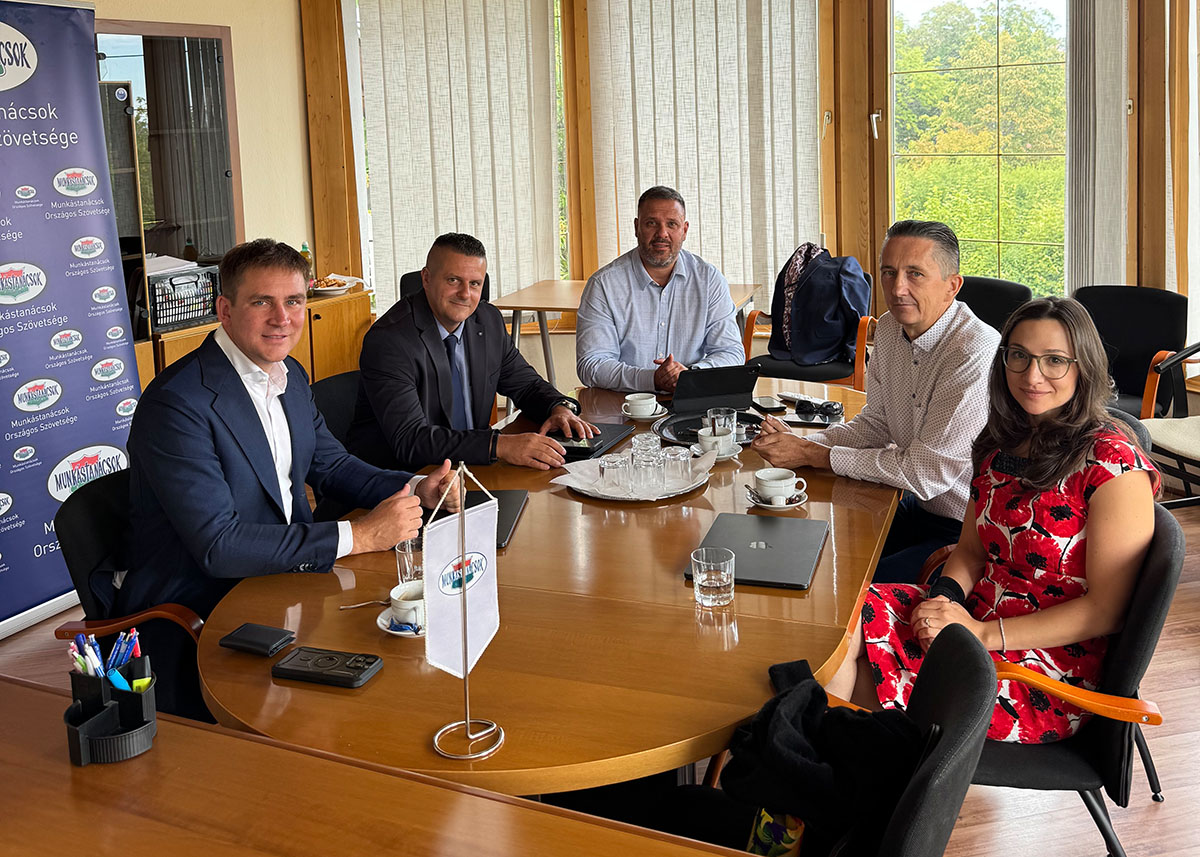
BUDAPEST – After a significant bilateral mission to Budapest, which saw a resurgence of pro-European sentiment in Hungary, the Union of Finance Personnel in Europe (UFE) reaffirmed its dedication to fostering a unified, robust, and progressive public finance system. Florian Köbler, President of the UFE and Federal Chairman of the German Tax Union (DSTG), met with László Szabó, President of the Hungarian Customs and Finance Workers’ Union (Vám- és Pénzügyi Dolgozók Szakszervezete – VPDSZ) and Vice-President of the National Federation of Workers’ Councils (Munkástanácsok).
The summit established a clear European perspective on the systemic transformations currently facing tax and customs administrations across the continent, including securing baseline administrative capacity during institutional restructuring, advancing sustainable civil service career models, establishing proactive standards for artificial intelligence and expanding regional dialogue across Central Europe.
Protecting Core Administrative Capacity: A European Principle
The discussions addressed the ongoing institutional shifts within Hungary, notably the establishment of the National Asset Recovery and Asset Protection Office (NVVH) and its operational implications for the National Tax and Customs Administration (NAV). For in-depth reporting on localised collective bargaining, recruitment mechanisms and domestic restructuring, readers can consult the comprehensive coverage published by the Hungarian economic journal Economx.
Taking a pan-European view, UFE President Florian Köbler and VPDSZ President László Szabó set out a clear baseline principle: specialised institutional reforms must never weaken the core foundations of ordinary revenue administration.
“Across Europe, frontline tax and customs officers guarantee the rule of law and secure the financial lifelines of our democracies,’ stated UFE President Florian Köbler. ‘While we support robust frameworks to protect public funds, siphoning highly qualified auditors from regular services to staff specialised units risks creating dangerous administrative vacuums. Institutional modernisation cannot become a zero-sum game that increases workload pressures for frontline personnel. The UFE will examine these systemic workforce challenges on a continental level during our upcoming UFE Congress in October.”
Governing AI: Championing the Human-in-the-Loop
The bilateral leadership emphasised that recruitment challenges, inflation and growing administrative demands necessitate a modern European career framework spanning several decades (élettapmodell).
They placed strategic priority on the accelerated adoption of artificial intelligence in public finance. Emphasising that technology must serve the public servant rather than diminish the profession, Köbler and Szabó called for a decisive, human-centric European approach.
“Digitalisation and algorithmic tools will transform routine administrative workflows, but they must never replace professional discretion, legal accountability and ethical judgement,‘ affirmed Florian Köbler. ‘The decisive question for Europe is not whether AI will be deployed, but who is preparing today’s workforce to command it. We must ensure proactive, high-level reskilling across all member states while maintaining the non-negotiable principle of the human-in-the-loop to safeguard constitutional due process.”
Fostering Regional Dialogue Across Central Europe
The consultations, which were based on a shared commitment to democratic engagement, also emphasised the importance of constructive dialogue within the local community. In this positive spirit of engagement, VPDSZ maintains an active exchange with counterpart unions in Poland, Slovakia and the Czech Republic.
Reflecting on past successful integration efforts, President Köbler extended an open invitation to representatives from these Central European partners to attend the upcoming UFE Congress in Portugal as observers.
“European cohesion thrives on continuous dialogue and open doors”, observed President Köbler. “Much like our constructive outreach to our Scandinavian colleagues in Luxembourg, we believe in building bridges without bureaucratic hesitation. Deepening the exchange among frontline financial personnel across Central Europe is a natural and necessary step towards a stronger, unified European public service.”
By sharing values, showing mutual respect and maintaining a unified vision, the UFE and its member organisations ensure that those safeguarding Europe’s public finances receive the institutional support, respect and resources they deserve.